 In Arizona, air conditioning is not a luxury, but an important part of any home. When summer temperatures climb well past 100 degrees, homeowners rely heavily on their AC systems to maintain comfort and safety, yet many people are unaware that poor attic insulation can quietly undermine AC performance, drive up energy bills, and shorten system lifespan. The attic plays a major role in how hard an air conditioner must work, especially in extreme desert heat.
Understanding how insulation affects heat load, duct efficiency, and overall system strain helps explain why some homes never seem to cool properly despite having a functioning AC unit.
Attic Heat Load Overwhelms the Home
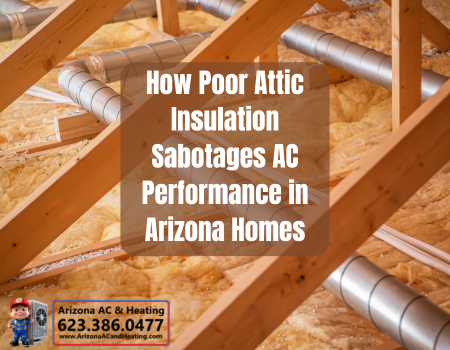
Arizona attics absorb an enormous amount of heat. On a summer afternoon, attic temperatures can easily exceed 140 degrees. Without adequate insulation, that heat transfers directly into the living space below.
Insulation acts as a thermal barrier, slowing the movement of heat from the attic into the home. When insulation is thin, uneven, or degraded, heat pours into the house faster than the AC can remove it. This creates a constant battle where the system runs longer and more often just to maintain the thermostat setting.
High heat load leads to uneven cooling, as rooms directly below the attic become warmer, while shaded or interior rooms may feel more comfortable. Homeowners often respond by lowering the thermostat, which increases energy consumption without fixing the underlying problem.
Over time, this constant heat intrusion makes the AC appear underpowered, even when it is working exactly as designed.
Duct Loss Happens in Hot Attics
Many Arizona homes have ductwork running through the attic, so when insulation is poor, those ducts are exposed to extreme heat, and even well insulated ducts can lose a significant amount of cooling capacity in a superheated attic.
As cooled air travels through hot ductwork, it warms before reaching living spaces, and this means the AC must work longer to deliver the same level of comfort. In some cases, by the time the air reaches the vents, it is several degrees warmer than intended.
Leaky ducts make the problem worse, so small gaps or disconnected sections allow conditioned air to escape into the attic, where it is quickly lost. At the same time, hot attic air can be drawn into the system, further reducing efficiency.
Duct loss is often invisible to homeowners because the AC still runs and blows air, so the issue is that the air delivered is not as cool or consistent as it should be.
System Strain Increases Wear and Tear
When attic insulation is inadequate, the AC system compensates by running longer cycles. While longer run times are sometimes normal in extreme heat, constant operation places strain on critical components.
Compressors, motors, and electrical parts wear out faster under continuous load. This leads to more frequent repairs and a higher risk of system failure during peak summer months. In Arizona, an AC breakdown in July or August is more than inconvenient, it can be dangerous.
Increased system strain also reduces efficiency, because an AC operating under constant stress consumes more energy, which shows up in higher utility bills. Homeowners may assume rising costs are simply part of living in a hot climate, not realizing that poor insulation is a major contributor.
Why Insulation Problems Go Unnoticed
Attic insulation issues are easy to overlook because they are out of sight. Many homeowners assume insulation remains effective forever, but materials can settle, shift, or degrade over time. In older homes, insulation levels may never have met modern standards to begin with.
Rodents, roof leaks, and previous renovations can also compromise insulation without obvious signs inside the home, and until comfort declines or energy bills spike, the attic rarely gets attention.
Improving Insulation Improves AC Performance
Upgrading attic insulation is one of the most effective ways to improve AC performance in Arizona homes. Proper insulation reduces heat load, keeps ductwork cooler, and allows the AC to operate more efficiently.
When insulation levels are adequate and evenly distributed, indoor temperatures stabilize, and so the AC reaches the thermostat setting faster and cycles more normally; energy use decreases, and comfort improves throughout the home.
Sealing air leaks and addressing duct insulation at the same time amplifies these benefits. Together, these improvements reduce system strain and extend equipment lifespan.
A Smarter Approach to Cooling
Poor attic insulation does not just affect comfort, it directly sabotages AC performance by increasing heat load, causing duct losses, and forcing systems to work harder than necessary. In Arizona’s extreme climate, addressing insulation is not optional. It is a foundational step toward reliable, efficient cooling.
For homeowners struggling with high bills, uneven temperatures, or frequent AC issues, the solution may not be a new system. It may be right above their heads.